Cultural Tours
12
15 Dyas
The tour starts from Karachi which is the capital of the Sindh province and the largest city and financial hub of the country.
Our aim is to trace a part of the Indus River all the way from near to where it flows into the Arabian sea – not far from Karachi – up to Multan. After Multan we will stop following the Indus river but we will be seeing some important side rivers when we drive up to Lahore. Extra emphasis lays on making stops at small villages along the way and having time to meet different kinds of local people and craftsmen. Besides that we think you should not miss some of the precious and most beautiful shrines in Uch Sharif and Multan and the historical places Makli, Mohenjo-Daro and Derawar Fort. These places are true gems and by visiting them you will get a better understanding of the rich history and culture of the whole area as well of the day to day life of the people that live there.
According to archaeologists, the key to the mysteries of the ancient Indus civilization lies buried in the sands of Cholistan. 400 archaeological sites have been discovered, but only few are excavated. The legendary Cholistan desert extends over 1700 square kilometres right into the Thar desert of Rajastan, India. The whole area is a desolate semi-desert expanse of sand and salt bushes. We will end the tour in Lahore which is Pakistan’s cultural and intellectual centre. The faded elegancy, busy streets, bazaars and a wide variety of Islamic and British culture make this a city of atmosphere, surprises and contrasts.
Karachi-Islamabad
Octorber to March
Easy
Normal
We will embark on a sightseeing tour of some of Karachi's most iconic landmarks, including Mohatta Palace, the Tooba Mosque, the Quaid-e-Azam Mausoleum, Frere Hall (Bagh-e-Jinnah), Empress Market, and Clifton Beach.
Mohatta Palace: Built in 1927 by Shivratan Chandraratan Mohatta, a self-made businessman from Marwar, this palace served as his summer residence. Designed by architect Agha Ahmed Hussain, the palace reflects the architectural style of Rajasthan, using a combination of pink Jodhpur stone and local yellow Gizri stone. Mohatta Palace remained in Mohatta’s possession only for about two decades before he left for India following the independence of Pakistan.
Mazar-e-Quaid (Quaid-e-Azam Mausoleum): This mausoleum, completed in the 1960s, is located in the heart of Karachi. It is the final resting place of Quaid-e-Azam Mohammad Ali Jinnah, the founder of Pakistan, and stands as a symbol of his vision for the nation.
Tooba Mosque: Known for its immense dome, often regarded as the largest single-dome mosque in the world, Tooba Mosque is built from pure white marble. The dome, measuring 72 meters (236 feet) in diameter, rests on a low surrounding wall without the need for central pillars. The mosque's design emphasizes acoustics, allowing voices spoken at one end to be heard clearly at the other.
Frere Hall (Bagh-e-Jinnah): A stunning example of British Colonial architecture, Frere Hall is now home to an art gallery (Sadequain Gallery) and a library, set amidst a peaceful garden. This historical building is a testament to the city’s colonial past.
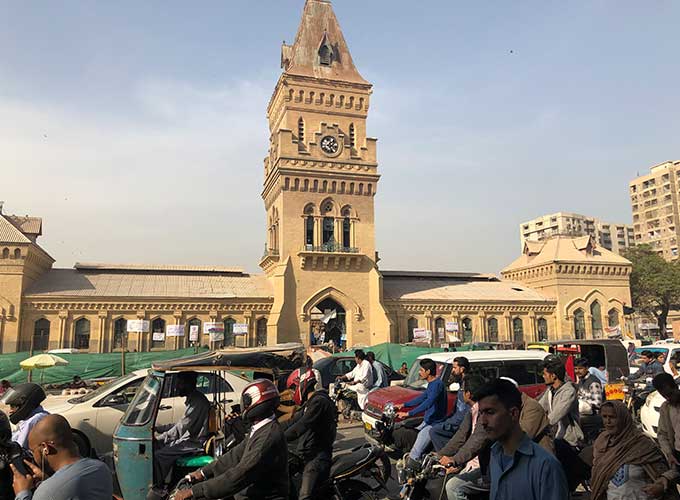
Empress Market: Constructed between 1884 and 1889 during the British Raj, Empress Market was named in honor of Queen Victoria, Empress of India. Today, it remains a bustling shopping hub, offering everything from fresh produce to textiles, stationery, and pet supplies, all while showcasing Karachi's historical charm.
Clifton Beach: Located in the heart of the city, Clifton Beach is one of Karachi’s busiest and most popular beaches. Visitors can enjoy camel and horse rides along the sands, and the area is lined with hawker stands selling refreshing cold drinks, tea, and grilled corn, making it a vibrant spot for both locals and tourists alike.
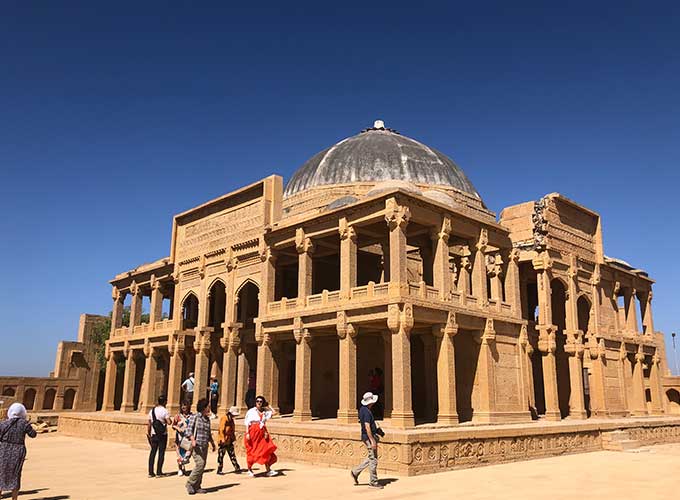
We drive from Karachi to Hyderabad stopping along the way at Haleji Lake, a haven for migratory Siberian birds and crocodiles; and Makli/Thatta, an ancient town that was a river-port and the capital of Sindh, until the Indus changed its course. Here we will visit Jamia Masjid, built by Shah Jehan, who went on to build the Taj Mahal, the delicately stone-carved Dabgir Masjid, and the Makli Necropolis, claimed to be the largest graveyard in the world.
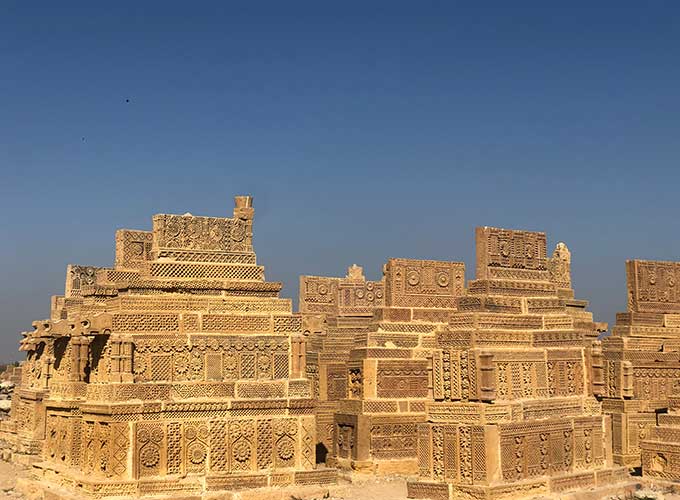
Thatta, once a capital and centre of Islamic culture is near the vast necropolis of Makli. Which gives great insight into the civilization of the Sindh from the 14th to the 18th centuries.
The enormous cemetery possessing half a million tombs and graves in an area of about 10 km2 is among the largest in the world. Kings, queens, governors, saints, scholars, and philosophers are buried here in brick or stone monuments, some of which are lavishly decorated with glazed tiles.
We drive out from Hyderabad to Ranikot Fort, also known as the Great Wall of Sindh, which is believed to be the biggest fortress in the world, and was the last stronghold of the Talpur Mirs before the British takeover. We then cross the Indus to visit Bhit Shah, the shrine of Shah Abdul Latif, Sufi saint and poet and the uncrowned king of Sindh. Especially beloved of the poor, there is a daily musical gathering at the shrine. We return to Hyderabad to explore its famous bazaar, the longest in Pakistan, and its many handicraft workshops.
Ranikot Fort is a historical Talpur fort near Sann, Jamshoro District, Sindh, it is known as The Great Wall of Sindh and is believed to be the world's largest fort with a circumference of approximately 32 kilometres. The site was nominated in 1993 by the Pakistan National Commission for UNESCO world heritage status, and has since been on the tentative list of UNESCO World Heritage Sites.
Bhitshah (59 km north of Hyderabad)
Bhitshah is famous as the last resting place of Shah Abdul Latif (1689-1752 A.D.) A great poet-saint of Sindh. Shah Abdul Latif chose this "Bhit" (sand dune or mound) as his permanent abode in 1744.
Leaving Hyderabad we drive to Sehwan, site of one of Alexander the Great’s fortresses, and the shrine of Shaikh Usman Marvandvi, popularly known as Lal Shabaz Qalandar, a 12thC Persian Sufi mystic, whose riotous annual festival is attended by thousands. Later we visit Manchar Lake, where fishermen descended from the original Indus Valley people use the same ancient fishing techniques.
Sehwan
Sehwan is an old town of pre-Islamic period. Here are the remains of Kafir-Qila, a fort reported to have been constructed by Alexander the Great. Sehwan is famous for the resting place of the great mystic poet, saint and scholar Shaikh Usman Marvandvi (1117–1274), popularly known as Shahbaz Qalandar whose mausoleum is visited by thousands of the devotees throughout the year.
Manchar Lake
Manchar is the largest fresh water lake in Asia it is as old as the Indus River and is spread over 254 square km. It is inhabited by boat men whose lifestyle – and boats – have remained unchanged since the days of the Indus Valley Civilization.
Leaving the beautiful garden city of Larkana we
drive to Mohenjo-daro, the most impressive and best-preserved ancient site on the Indian sub-Continent. An entire city belonging to the Indus Valley Civilization, contemporary with that of Ancient Egypt and Sumeria, it displays advanced town-planning techniques. Later we continue to Sukkur via Bukkur, an island in the Indus surmounted by a fort and surrounded by shrines dedicated to river-gods. Sukkur itself contains much of interest; Sateen Jo Astaan (the tombs of the seven
sisters) and Masoom Shah Jo Minaro both places give
great views of the area and have an interesting history.
We leave Sukkur via the Lansdowne bridge and the stupendous irrigation works completed by the British. We drive north and enter the Punjab, stopping at Uch Sharif, which contains some of the most poignant ruins in Islamic antiquity, notably the Tomb of Bibi Jewindi. We continue on to the charming city of Bahawalpur.
Uch Sharif means "The High Place". The small town is built around a hill overlooking the confluence of the rivers Sutluj and Chenab. It is famous for its exquisite Sufi Shrines which are open for public.
We drive to Derawar fort, a huge citadel towering over the surrounding Cholistan desert, where we will meet some of the desert people and learn something of their way of life. In the evening we drive to Multan
The Derawar Fort towers over the surrounding semi-desert and is visible from miles around, the marble and blue tiled tomb of the knights and their families lies a few hundred yards to the East of the Fort.
All day sight-seeing around the monuments and bazaars of Multan, the ancient capital of Lower Punjab, and renowned as the City of Sufis. The Tomb of Shah Rukn-i-Alam is a must-see, as is the shrine of Shams-ud-din Tabriz. Multan is a centre for the production of fine embroidered cottons, tilework, ceramics and traditional camel-skin lamps, and also famed for its halwa and mango chutney.
Leaving in the morning we drive to the ancient site of Harappa, contemporary with Mohenjo-Daro, but also containing the remains of a later Bronze and Iron-Age city. We then continue to Lahore for our overnight stay. When driving to the hotel in Lahore we might already see some beautiful landmarks like the Minar-e-Pakistan, the Town Hall, the GPO (General Post Office) and the Governor’s House.
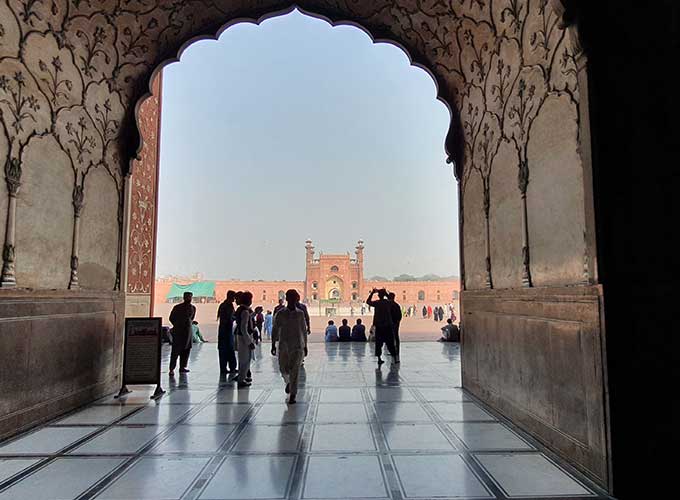
Full day sightseeing tour: the Lahore museum, the Badshahi mosque, the Lahore Fort (Shahi Qila) and at the end of the afternoon the Wagah border flag ceremony. Overnight at a hotel in Lahore.
Lahore Museum:
The Lahore Museum contains some fine specimens of Mughal and Sikh door-ways and wood-work and has a large collection of paintings dating back to the Mughal, Sikh and British periods. It includes a collection of musical instruments, ancient jewellery, textiles, pottery, and armory. There are important relics from the Indus Valley civilisation, Gandhara and Graeco-Bactrian periods as well as some Tibetan and Nepalese work on display. The Fasting Buddha from the Gandhara period is one of the most famous objects of the museum. The ceiling of the entrance hall features a large mural by renowned Pakistani artist Sadequain.
On our sightseeing tour today we will be making a tour of the Old Walled City including the Wazir Khan mosque and the Shahi Hammam. In the afternoon we will visit the Shalimar Gardens and the Tombs of Jahangir, Nur Jahan and Asif Khan.
Overnight at a hotel in Lahore.
Wazir Khan Mosque Complex:
The Wazir Khan Mosque is known for its extensive faience tile work, it contains some of the finest examples of Qashani tile work from the Mughal period.
Hiran Minar is an early 16th-century Mughal era complex located in Sheikhupura, the complex was built at the site of a game reserve in honour of Mughal Emperor Jahangir's beloved antelope named Mansraj.
Sheikhupura Fort is a Mughal-era fort built in 1607 near the city of Sheikhupura, it was built during the reign of Emperor Jahangir. The fort was drastically altered during the Sikh-era, with numerous buildings constructed - some with exquisite Sikh-era frescoes. In 1808, the fort was conquered by the six-year-old of Maharaja Ranjit Singh, Prince Kharak Singh. In mid 19th century when power turned to the British, the fort of Sheikhupura was used for the 'house arrest' of Maharaja’s last queen, Maharani Jind Kaur the mother of Maharaja Duleep Singh.
From the cultural “capital” Lahore we will drive west to the capital of Pakistan, the city of Islamabad, half way we make a stop to visit the Katasraj Temple and explore the Khewra Salt Mines. Dinner & overnight at hotel in Islamabad Katasraj Mandir is a Hindu mandir or temple complex situated in Katas village near Choa Saidanshah dedicated to Shiva. The smaller temples, built in pairs around the larger central temple, were built around 900 years or so ago, although the earliest of them dates back to the latter half of the 6th century AD. The Katas site houses the Satgraha, a group of seven ancient temples, remains of a Buddhist stupa, a few medieval temples, havelis and some recently constructed temples, scattered around a pond considered holy by Hindus. The Khewra Salt Mine (or Mayo Salt Mine) is located in Khewra, is Pakistan's largest and oldest salt mine and the world's second largest. Its history dates back to its discovery by Alexander's troops in 320 BC, but it started trading in the Mughal era.
Your last day in Pakistan! We will have a sightseeing tour in Islamabad which will consist of a selection of some of the following sites: the Faisal Mosque, the Government buildings on Constitution Avenue, the Shakar Parian Park with its rose and jasmine garden, the Pakistan Monument, the Lok Virsa heritage museum, Saidpur village, Rawal Lake, Daman-e-Koh viewpoint. Our goodbye dinner will be at Monal restaurant on the top of the Margalla Hills.
Breakfast: Our breakfast typically includes a variety of options such as omelets, fried or boiled eggs, fried Pakistani bread (paratha), chapati, toast, pancakes, porridge, cereal, jam, Nutella, honey, marmalade, cheese, and more, served with green tea, coffee, or milk tea.
Lunch: Unlike other trekking agencies, we offer a fresh, wholesome lunch instead of packed meals. This includes soup, tuna fish, boiled potatoes, eggs, assorted cookies, bread, cheese, dried fruits, and nuts, along with green tea, coffee, or juice.
Dinner: Each dinner begins with a warm soup, followed by a variety of dishes that change daily. These may include different vegetable dishes, a selection of meats (chicken, beef, or mutton), served with rice, noodles, pasta, lentils, potatoes, French fries, and chapati bread. For dessert, we offer fresh fruit or pudding at every meal.
Snacks: Between lunch and dinner, we provide a daily selection of snacks, such as cookies, pakoras, and popcorn, along with hot beverages.
Note: We accommodate specific dietary needs, including vegetarian, vegan, and lactose-intolerant diets. Please feel free to contact us for more information on dietary options.
The timing of your flight will depend on your specific itinerary and preferences, wherever possible. For the standard K2, K2 Gondogoro La, and Snow Lake treks, we typically schedule the flight on day 2 of your itinerary, flying from Islamabad to Skardu.
It's a valid question, as the news from Pakistan often focuses on the negative, but the image many people have abroad is far from the reality. While there were legitimate concerns in the past about safety, a lot has changed in recent years. The security situation has improved significantly, and the government has been making concerted efforts to promote tourism and facilitate travel.
When you visit, you'll quickly notice the warmth and hospitality of Pakistanis. They are eager to meet visitors and often extend invitations to their homes. Pakistan is a large and diverse country, and we only offer tours and treks to areas we consider safe. We currently do not recommend traveling to the border regions with Afghanistan and certain parts of Balochistan, but most other areas are safe to visit without any issues.
Yes and no, it is your own responsibility to select a trek that is suitable for you in terms of you personal fitness level as well as experience – if you book a private trek then you have all the flexibility to customize it and for example add extra days or extra supporting staff if needed. If you book a trek with an open group then we try to only let people join who have a certain experience level. Please don’t hesitate to contact us in case you would like us to help you select the best trek for you.
Yes, all the tours and treks that we offer on our website can be completely customized to your own requirements. We are also happy to design a tailor-made tour for you from scratch. Just let us know your preferences, special interests, number of days you have available etc. and we will send you our personalized itinerary suggestions.
For certain types of treks you will require a trekking visa – for example all the K2 treks. If a trekking visa is required then we will inform you accordingly during your booking, there are a lot of treks which are not in a restricted area and therefore you will only need a standard tourist visa.
If you have to apply for a standard tourist visa then 1 month in advance should be sufficient – in most cases you will receive your visa within a few days / a week – you should not apply more than 3 months in advance. If you have to apply for a trekking visa then you will need to be prepared for a longer processing time, we recommend to apply 3 to 2 months in advance.
Yes, it is possible to rent certain items from us or we will put you in contact with a trusted local supplier who can provide you with the things you need. Some of the standard gear which we can arrange are crampons, climbing belts, ice axes and climbing helmets.
The summer period is the main trekking season in the north of Pakistan. For most treks this would be from June to September with July and August being the best months.
This will depend on the type of tour that you are planning. Please make sure to consult your travel insurance before your trip to make sure you have proper coverage for your tour and the activities you will undertake. Especially when you go on a trek it is important to have mountain emergency search and rescue / repatriation by helicopter included in your insurance package.
WhatsApp us